

Cohabitation is highly popular and rapidly increasing in Ireland, marking a significant shift in family structure.
While marriage remains common, cohabitation is frequently used as a precursor to marriage or as a long-term alternative, particularly among younger, urban populations
The most recent Central Statistics Office figures show that there is a massive increase in cohabiting families
Rapid Growth: The number of cohabiting couples without children increased by 17% between 2016 and 2022.
Families and Children: Census 2022 found 85,262 cohabiting couples living with children, a 12.7% increase from 2016.
Cohabitation -v- Marriage?
While there has been major progress on this front, it’s crucial to understand that cohabiting couples simply do not enjoy the same legal status as married couples. Here are some of the key differences:
- Property rights: Cohabiting couples do not automatically have rights to each other’s property in the same way married couples do. So should the property be owned by one partner, the owner can sell or lease the property without the consent of the other.
- Inheritance: Unlike married couples, a cohabiting partner does not automatically inherit from the other unless specified in a will.
While Irish law does recognise certain rights for long-term cohabitants, these rights are not automatic, particularly when it comes to succession and inheritance.
Under Irish law, qualified cohabitants may make an application for redress following the breakdown of a relationship or the death of a partner. Such applications may seek financial support, property adjustment orders, pension adjustment orders, or a share in the assets of a deceased partner.
Who Is a Cohabitant?
Cohabitation is governed by the Civil Partnership and Certain Rights and Obligations of Cohabitants Act 2010 (the “2010 Act”). The Act provides a redress scheme for cohabitants on the breakdown of a relationship or on the death of a partner.
A cohabitant is one of two adults (whether of the same or the opposite sex) who ‘live together’ as a couple in an ‘intimate and committed relationship’.
They must not be in a prohibited degree of relationship (e.g. sibling, first cousin), married or civil partners of each other.
Each case will raise questions of fact, such as, were the parties living together, was the relationship intimate and committed, how long was the relationship, and when did it end?
The relationship must be more than a ‘mere friendship’ or dating relationship, but the parties do not have to be living ‘physically at all times in the same shared premises.’
‘Intimate and committed’ means that the parties must be, or must have been, sexually intimate. The Court will look at the checklist set out in the Act, such as the length of the relationship and financial arrangements. However, the degree of shared activities, household chores and shared holidays can also be accepted as proof of an intimate and committed relationship.
How long do you have to be living together to qualify ?
Not all cohabitants qualify for legal protection under the Act. Only qualified cohabitants may seek redress.
To avail of the Act, you must be a ‘qualifying cohabitant’.
This means cohabiting for:
- Two years, if you have dependent children, or
- Five years, in any other case.
A couple will not qualify if they cannot marry because they are not divorced or entitled to be divorced.
A qualified cohabitant must prove that they are financially dependent because of the relationship or the ending of it.
Legal Rights on the Breakdown of a Relationship
If the Court is satisfied that it is ‘just and equitable,’ it may make certain financial orders, such as a transfer of property, maintenance or pension payments.
In making a decision, the Court will look at:
- The financial needs and obligations of each person.
- The entitlements of any prior spouse or civil partner.
- The entitlements of any dependent child of a previous relationship.
- The duration & basis of the relationship and the degree of commitment to one another.
- The contributions made, including any contribution made to the income and earning capacity of the other.
- Any contributions made by either of them in looking after the home.
- The effect on the earning capacity of each cohabitant of the responsibility assumed by each of them;
- The extent to which the earning capacity of one may have been impaired by reason of having relinquished or foregone opportunity to look after the home.
- Any physical or mental disability of the qualified cohabitant
- The conduct of each of the cohabitants, if conduct is such as it would be unjust to disregard it.
An application for redress under the 2010 Act must be made within two years of the breakdown of the relationship. If this time limit is missed, the claim may be statute-barred.
Cohabitants’ Agreements
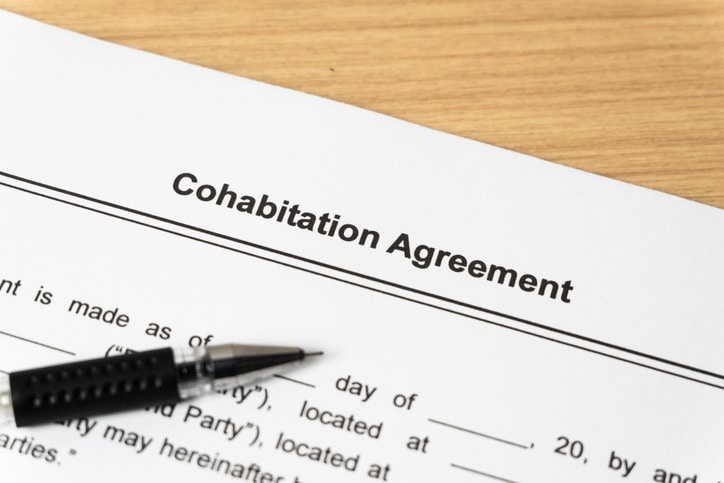
The Act provides that cohabitants can enter into a cohabitants’ Agreement on financial matters during or at the end of the relationship.
This is an encouragement to couples who do not want to marry to take control of their own arrangements.
A Cohabitants’ Agreement must be in writing and signed with legal advice.
Succession Rights: What Happens When One Partner Dies?
Unlike spouses or civil partners, cohabitants have no automatic right to inherit, regardless of the duration and nature of the relationship.
Where there is no will, a surviving cohabitant is not entitled to any share of the estate under the Succession Act 1965, even where there are children or significant financial dependence.
Applying for Provision from the Estate of a deceased cohabitant
A qualified cohabitant may apply to the court for provision from a deceased partner’s estate. This application must be made within six months of the grant of representation.
If the relationship ended more than two years before the death, no application can be made. In cases involving the death of a cohabitant, financial dependence is less central than it is in a relationship breakdown. The Court may make provision where it is satisfied that proper provision was not made during the deceased’s lifetime. However, the award cannot exceed what a spouse would have received and may be significantly less.
The Bereaved Partner’s Pension
The Bereaved Partner’s Pension is a weekly social welfare payment made to the partner of a deceased person. While it was previously limited to spouses and civil partners, from July 2025 it has been extended to include qualified cohabitants.
The payment is not means-tested and may be available provided:
The relationship had not broken down prior to death; and
Both parties satisfy the relevant PRSI contribution conditions.
How are cohabitants treated for the purpose of taxation?
Cohabiting couples are not taxed the same way as married couples. In general, they are taxed as single individuals.
- Income Tax: Married couples can share their tax reliefs and allowances between them. Cohabiting couples are taxed as single individuals.
- Capital Acquisitions Tax (CAT): Transfers between spouses and civil partners are exempt from CAT.
- If you get a gift or inheritance from your cohabitant, it is taxed in the same way as if it was from someone who is not related to you. The lowest tax-free threshold of €20,000 applies with CAT at a rate of 33% applying to the excess.
Conclusion
Many cohabitants are surprised to learn how restricted their rights can be without marriage or appropriate legal planning.
Understanding your rights and the potential risks is essential.
Early planning, including the preparation of a Cohabitants’ Agreement and a valid will, can significantly reduce uncertainty and protect both partners.
We would always advise people to plan in advance and at a time when there is no likelihood of conflict. This means doing it before the relationship ends.